




Unsolicited SEO spam emails sent from a free Outlook account has led back to Indian digital marketing and web development company Tech Zenon IT Solutions Pvt. Ltd.
The initial spam email came from Rajesh Verma using the address rajeshvermaseo@outlook.com. It promoted SEO services without making Tech Zenon’s involvement clear through the sender’s email domain.
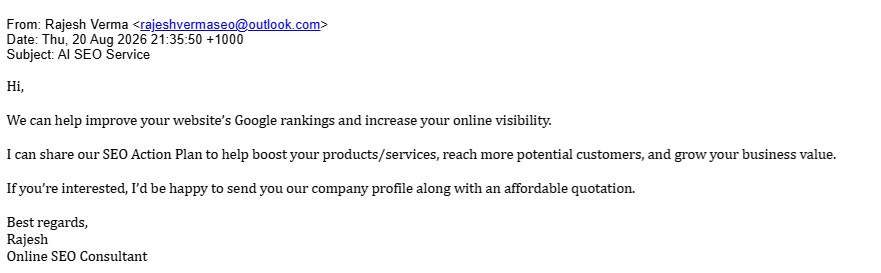
After Tech Business News replied to the Outlook address, the conversation shifted to a company account. The response came from Aditya Singh at aditya@techzenon.com, who identified himself as Senior Business Development Manager at Tech Zenon IT Solutions Pvt. Ltd.
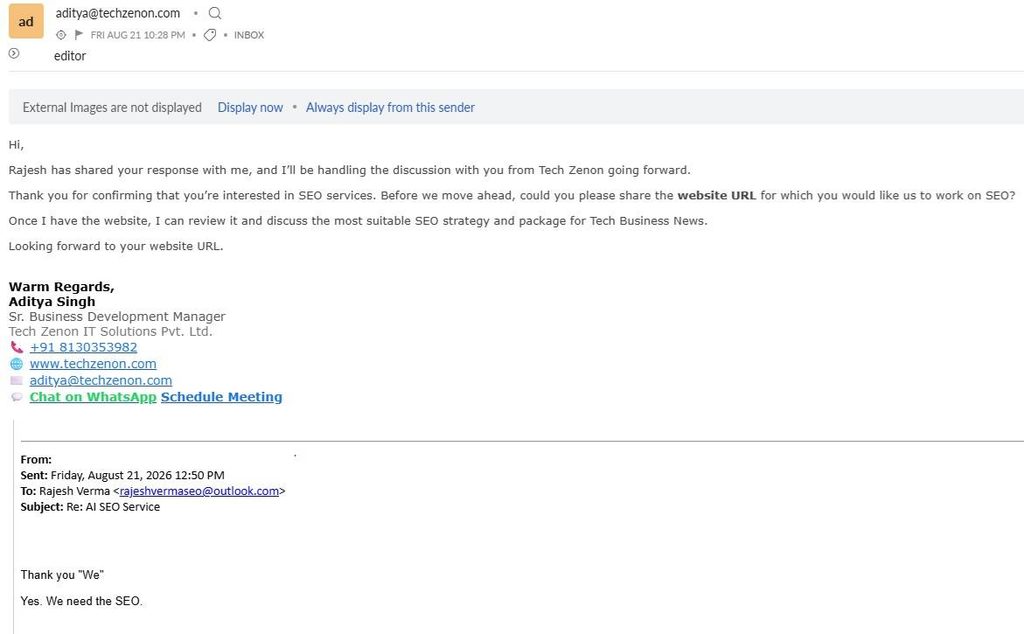
That connection matters because Tech Zenon is not an anonymous freelancer or a business without its own communications infrastructure.
The company operates techzenon.com, publishes company email addresses and promotes SEO, digital marketing, web development, mobile application development and related technology services.
Its website lists a head office at B-149, 2nd Floor, Sector 63, Noida, Uttar Pradesh, India. It also provides a general business email address and phone number, making the decision to begin the approach through Outlook even harder to understand.
The email trail does not establish whether Rajesh Verma is employed directly by Tech Zenon, works as a contractor or was carrying out lead generation through another arrangement.
What it does show is that replying to his Outlook address resulted in a response from a senior business development manager using Tech Zenon’s company domain.
For website owners, publishers and small businesses, the pattern has become painfully familiar. An SEO offer arrives from Outlook, Gmail or another free email service, but the actual company behind the sales approach is only revealed after the recipient replies.
The first message often says a website has ranking problems, lost traffic or missed opportunities, although little or no evidence is provided that a proper audit has taken place.
Its immediate purpose appears to be getting a response, which then opens the door for a more formal sales pitch from the company benefiting from the lead.
This kind of outreach has become one of the most irritating parts of operating a website. Tech Business News recorded 1,671 unsolicited emails promoting questionable SEO services during 2025 alone, with many arriving from free email accounts that provided little information about the business behind them.
The names and addresses constantly change, but the offers are usually much the same. Website owners are promised higher Google rankings, stronger domain authority, more traffic, backlinks, guest posts or fixes for supposed SEO problems that have never been properly explained.
In many cases, the sender appears to have done little more than locate an email address on a contact page. The message is written to look personal, but the lack of specific information about the website strongly suggests it could have been sent to hundreds or thousands of other recipients with only the domain name changed.
Free email accounts keep the real business at a distance
There is nothing inherently suspicious about using Outlook or Gmail, and millions of legitimate sole traders rely on free email services. The concern begins when an established company with its own domain appears only after a recipient responds to an unidentified commercial approach.
Sending the first message from a personal account keeps the company’s main domain away from the initial complaint. If the Outlook address is reported, blocked or abandoned, the company domain may avoid the same damage to its sender reputation.
That does not prove this was Tech Zenon’s intention, but it is one reason the practice attracts so much suspicion. A business confident in its services should be able to identify itself at first contact and accept responsibility for the marketing it authorises.
Tech Zenon presents itself publicly as an established technology and marketing company. Its website advertises SEO packages, ecommerce SEO, pay-per-click advertising and social media optimisation, while its LinkedIn page says the privately held Noida company has between 51 and 200 employees.
Against that public image, the Outlook approach looks surprisingly informal. A company selling digital credibility and online visibility should understand why potential customers may distrust an email that does not clearly show who stands to benefit from the sale.
The contradiction becomes even more obvious when the service being promoted is SEO. Agencies tell businesses they can build organic traffic and improve search visibility, yet some still appear to depend on bulk unsolicited email to find their own customers.
Good marketing should create enough reputation, visibility and referral activity for people to find the company. When the agency instead appears through an unexpected Outlook message, it invites a reasonable question about how well its own marketing is working.
Australian spam rules require clear identification
The email also raises broader questions under Australian spam rules because it was sent to an Australian publisher. The Spam Act 2003 prohibits unsolicited commercial electronic messages with an Australian link and requires commercial messages to contain accurate sender information and a functional unsubscribe facility.
The Australian Communications and Media Authority says businesses must accurately identify the person or company sending or authorising a marketing message. Correct contact details must also be provided, even when another person sends the email on the company’s behalf.
ACMA also says consent remains the sender’s responsibility. Businesses using purchased lists, outside marketing contractors or lead-generation services must still make sure recipients have consented to receive the messages.
Every commercial message must also provide a clear way to unsubscribe, with requests processed within five working days. ACMA warns that businesses can still be held responsible when another party sends messages for them or when they work with someone engaging in conduct that breaks spam rules.
Whether the email involving Rajesh Verma and Tech Zenon amounts to a breach would ultimately be a matter for ACMA or another relevant regulator to determine.
However, the use of an Outlook address followed by a company-domain response is exactly the kind of layered identity that makes it harder for recipients to understand who contacted them and why.
The problem stretches well beyond one company. Website owners regularly receive similar pitches from agencies across several countries, while Microsoft and Google continue trying to prevent spam without blocking every ordinary message sent through their free email platforms.
These emails are often not phishing attempts and usually contain no malware, which makes them more difficult for automated systems to stop. They sit in a grey area where a message may look like an individual business enquiry until the recipient replies and discovers it was the opening step in a sales campaign.
For publishers, the damage goes further than a cluttered inbox. Legitimate editorial pitches, reader messages and genuine business enquiries can be missed because they are buried beneath fake website audits, backlink offers and vague promises of first-page Google rankings.
The constant stream also damages trust in the wider Indian technology sector, which includes many skilled and reputable developers, engineers and marketing professionals.
Businesses using anonymous or loosely identified outreach make legitimate Indian companies look less credible, even though most have nothing to do with these campaigns.
Tech Zenon has a public website, a named office, company telephone numbers and its own email system. There was no obvious reason for its connection to the offer to emerge only after Tech Business News replied to Rajesh Verma’s Outlook address.
If Rajesh was authorised to generate business for Tech Zenon, the company should have been identified clearly in the first email. If he was not authorised, Tech Zenon should be concerned that replying to his message led directly to one of its senior business development managers.
Either possibility deserves an explanation because recipients should not have to respond to an unidentified SEO pitch before learning which company is trying to sell them something. For an industry built around visibility and trust, hiding the business until the second email sends entirely the wrong message.
Other Implicated SEO Spammers Based In India
India’s SEO Spam Industry Floods Global Inboxes With Random Email Pitches
Unsolicited emails offering SEO, web development and guaranteed Google rankings have become a daily nuisance for businesses around the world, with many campaigns linked to digital marketing operations in India.
The emails usually follow a familiar script. The sender claims to have reviewed a website, warns that it performs poorly in search results and then offers cheap SEO, link-building or development work. Many arrive through free Outlook or Gmail accounts, making it difficult to identify the company behind the pitch.
Spam represented 44.99 per cent of global email traffic in 2025. Users also encountered more than 144 million malicious or potentially unwanted email attachments during the year, a 15% increase. In the first quarter of 2026, the company blocked more than 140 million phishing and scam attempts.
India’s technology sector is expected to generate US$315 billion in the 2025-26 financial year and employ almost six million people. Nasscom also estimates that AI-related revenue will reach between US$10 billion and US$12 billion.
Most Indian technology companies have nothing to do with spam, but the country’s enormous pool of developers, freelancers and digital agencies has also produced a less accountable market built around scraped email addresses and mass outreach.
Content Disclaimer
The information contained in this press release is submitted by an external source.