




A familiar email pitch, this time from Web Digital Media Group based in India has again exposed the murky world of offshore SEO spam, where anonymous inbox bait, disposable identities and outdated ranking promises are still being pushed at website owners around the world.
- Indian SEO, Marketing and Web Design Firm, linked to anonymous outreach complaints
- Anonymous Gmail.com and Outlook.com sales pitches raise questions over offshore lead generation tactics
- Web Digital Media Group named in spam email complaints
An Indian-based digital marketing and web development agency, Web Digital Media Group, has been identified in a growing wave of SEO spam emails targeting website owners, publishers and small businesses across Australia and overseas.
The company, which operates from Delhi NCR and promotes SEO, web development, app development and lead generation services through webdigitalmediagroup.com, emerged after Tech Business News responded to an anonymous Gmail message offering vague “actionable recommendations” to improve website visibility.
The first email did not come from Web Digital Media Group’s business domain.
The first message was sent from anshusingh016281@gmail.com, but it did not clearly identify the business behind the approach.
It carried no proper company signature, listed no website, included no street address and offered no unsubscribe option.
The message was short, thin and familiar to almost anyone who owns a website.
“Hello,” it read. “I found some actionable recommendations that may help increase your website’s visibility. Reply ‘Interested’ to receive them.”
It was signed only as “Eills”.
That was the bait.
When Tech Business News replied, the response came from Danish at danish@webdigitalmediagroup.com, identifying the company as Web Digital Media Group.
The follow-up email promoted a monthly SEO package, claimed there was a “massive opportunity” to scale organic reach in 2026, and said the company’s goal was to secure Page 1 Google rankings within three to four months for “high-intent keywords”.
The agency offered what it called a Startup SEO Package for US$199 per month, presenting it as a discounted rate from US$249.
That sequence — anonymous Gmail first, company-domain sales pitch second — is now at the centre of renewed concerns about the global SEO spam industry, where small agencies and lead generators use free personal email accounts to avoid exposing their real business domains to spam complaints, blacklists and sender reputation damage.
For website owners, the tactic is instantly recognisable.
The emails arrive from Gmail, Outlook or Hotmail accounts under names that often appear fake, incomplete or impossible to verify. They claim a website has ranking issues, visibility problems or missed SEO opportunities, but rarely include evidence that any real audit has been conducted.
The goal is not to provide insight.
The goal is to trigger a reply.
Once a website owner responds, the sender can reveal the actual agency, shift into a sales pitch and claim the conversation has become a lead rather than a cold commercial approach.
Cybersecurity and email compliance specialists have long warned that this type of outreach sits in a high-risk area of global anti-spam regulation, particularly when commercial emails fail to identify the sender, omit proper contact details, or provide no clear unsubscribe mechanism.
In Australia, commercial electronic messages are regulated under the Spam Act 2003. In the United States, similar conduct can raise issues under the CAN-SPAM Act. In the United Kingdom, electronic marketing is covered by the Privacy and Electronic Communications Regulations.
The rules differ between jurisdictions, but the basic principle is not complicated: if a business sends marketing emails, recipients should know who is contacting them, why they are being contacted, and how to stop receiving further messages.
The first email seen by Tech Business News did not do that.
It gave no clear business identity at all.
Web Digital Media Group lists itself online as a digital marketing, SEO and website development company. Contact details associated with the business include India-based phone and email details, along with claimed international contact points in markets including the United States and the United Kingdom.
Material reviewed by Tech Business News also identified the company with a Delhi NCR location at B-90, 3rd Floor, Sector-63, Noida Electronic City, while the company’s published website lists Noida contact details and an India phone number, +91 8800278502.
The shifting and layered nature of those details adds to the concern for website owners trying to establish who is actually behind the approach, where the business is operating from, and why the first contact was made through an unidentified Gmail address.
The company’s own SEO packages also raise questions about the services being promoted.
Alongside standard SEO tasks such as title tag optimisation, meta tag work, image alt tags, robots.txt creation and XML sitemap setup, Web Digital Media Group advertises off-page activities including article submissions, article marketing, third-party blog pinging, social bookmarking and monthly backlink counts.
Its published Startup package lists 30 totally worthless spammy backlinks per month. Higher packages list larger backlink numbers.
For serious SEO professionals, that is where the pitch begins to look less like a modern search strategy and more like a throwback to a much older and dirtier period of the industry.
Article submissions, social bookmarking, link wheels, blog pinging, logo submissions and bulk backlink counts have been treated with suspicion for years.
Many of these tactics are associated with low-quality link building, artificial authority signals and spam-style promotion that provides little meaningful value to a business trying to build long-term search visibility.
The irony is difficult to miss.
Agencies that claim they can get other businesses to rank on Google are often unable to generate enough credible inbound interest for themselves. Instead, they use disposable Gmail accounts, vague names and bulk outreach to sell “organic growth” to people who never asked for it.
That is the awkward truth at the heart of the SEO spam economy.
If a company can genuinely build search authority, it should not need to hide behind a free inbox and a fake-sounding sender name to find customers. It should be visible through its own reputation, its own rankings, its own referrals and its own legitimate business channels.
Yet millions of website owners continue to receive these messages every year.
Some report receiving five or ten a day. Others say the number can climb past 20 or 30 during heavy spam periods, with each message arriving from a different free email account and each one pretending to be a fresh discovery, a personal audit or a helpful warning about search performance.
Tech Business News recorded 1,671 unsolicited emails promoting questionable SEO services in 2025 alone.
The pattern is rarely subtle.
One day the pitch claims a website has “SEO errors”. The next day it offers guest posting. Then comes web development, mobile app design, link insertion, domain authority improvement, local SEO, Google ranking support or “high-quality backlinks”.
The sender names change. The Gmail accounts change. The grammar changes slightly. The business model does not.
Industry sources say some of these campaigns are run directly by small agencies, while others appear to be handled by freelancers, commission-based prospectors or offshore lead-generation operators who scrape websites and send mass cold emails on behalf of SEO firms.
In some cases, the agency receiving the lead may argue it did not personally send the first email. That defence is unlikely to satisfy website owners whose inboxes are being flooded by anonymous accounts that later connect back to real commercial businesses.
If an agency benefits from the lead, the method used to generate it matters.
The use of free email accounts is especially revealing. A legitimate company sending legitimate marketing can use its own domain, identify itself clearly and accept accountability for the message.
A company or lead generator using anonymous Gmail and Outlook accounts is doing something different.
It is protecting the business domain from complaints.
If the free account is blocked, reported or abandoned, another can be created. The company domain remains cleaner. The sales team still receives replies. The recipient is left dealing with yet another spam approach that should never have reached the inbox in the first place.
Free email providers are also under pressure over the scale of the problem. However, little seem’s to have been done curb the constant barrage of these annoying spam emails.
Google, Microsoft and other major platforms say they repeatedly strengthened spam detection and sender rules, particularly around bulk email authentication and abuse prevention. But this style of SEO spam often slips through because it is not always malware, phishing or an obvious scam.
It is usually just unwanted commercial outreach dressed up as a personal note.
That grey zone is where the problem thrives.
For small business owners, publishers and website operators, the cost is time, trust and attention. Inbox fatigue makes legitimate emails easier to miss. Genuine suppliers are treated with suspicion. Editors delete real pitches because they are buried among fake audits and backlink offers.
Spam activity also raised in public Trustpilot reviews
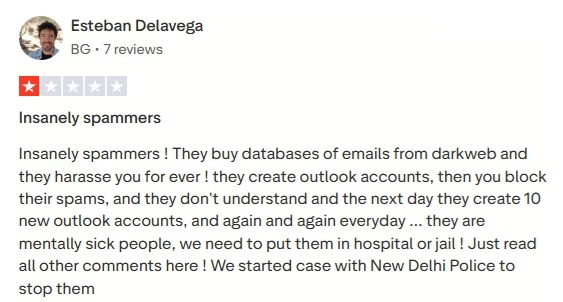
The company’s alleged spam activity has also been raised in public Trustpilot reviews, where several users have accused Web Digital Media Group of persistent unsolicited email campaigns.
One review attributed to Esteban Delavega described the company as “insane spammers” and alleged that its operators buy email databases, create Outlook accounts and continue sending messages even after recipients block them. The reviewer claimed the emails continued “again and again every day”.
Another review, attributed to Andrew W, said the use of spam emails undermined the credibility of any marketing agency. “Why do they need to spam email from an unrelated private email address if they are successful marketers?” the review said.
A separate review attributed to Este Ban alleged “cyber harassment for years”, claiming the company continued sending daily spam despite repeated requests to stop.
The review pattern also raises further questions about reputation management around the company.
While negative reviews accuse the business of persistent unsolicited outreach, a number of highly favourable reviews appear alongside them, creating the impression of an attempt to push older critical comments further down the page.
Tech Business News has not independently verified whether those positive reviews are genuine, but the contrast between the complaints and the glowing endorsements adds another layer of concern around the company’s online marketing practices.
The damage is also reputational for India’s wider technology sector.
India has a large, skilled and legitimate digital services industry, with serious developers, engineers, marketers and technology companies serving global clients. But the low-tier spam economy keeps dragging that reputation backwards, one anonymous Gmail pitch at a time.
The worst operators trade on volume, not trust. They scrape contact pages, send vague claims, hide their business identity and then offer outdated SEO packages built around tactics that stopped being impressive more than a decade ago.
Web Digital Media Group is now the latest company identified in that pattern.
The company presents itself as a global digital agency. The email trail seen by this publication shows something far less polished: an anonymous Gmail opener, a delayed business reveal, a low-cost SEO retainer and a package of old-fashioned link-building tactics wrapped in modern sales language.
Website owners are no longer fooled by it.
They are tired of the fake names, tired of the pretend audits, tired of the Gmail accounts and tired of companies promising Page 1 rankings while using spam to find their own customers.
For an industry built on visibility, the contradiction is brutal.
Meanwhile, the contradiction is difficult to ignore. These SEO and marketing operators claim they can deliver search visibility for clients, yet appear unable to build enough visibility for their own websites, leaving bulk email spam as their own business strategy.